
Insights
How to detect inverter faults early across many sites (and cut truck rolls)
Early signals, grouping repeat alarms and checking remotely first, so technicians only drive out when they need to.
Andreas Lehner, CCO · 2 min read
Published
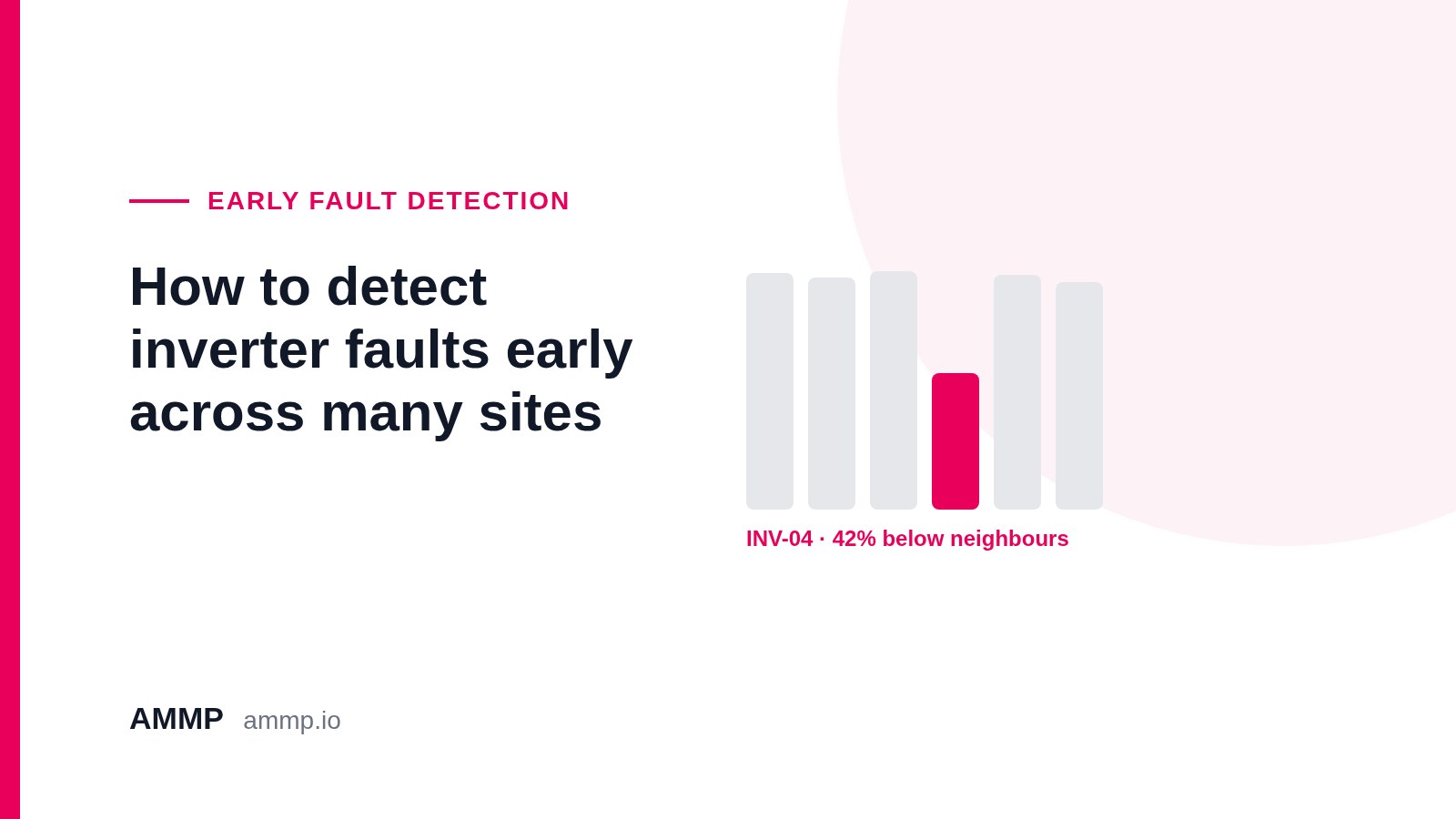
On a large portfolio, inverter faults rarely announce themselves. One unit drops a few percent, another trips and restarts every afternoon, a third stops reporting. Each is small. Together, and over months, they add up to real lost revenue and many wasted site visits.
Early signals worth watching
- Against neighbouring inverters: same site, same weather, same orientation. An inverter that falls behind its neighbours (relative to DC capacity) is the clearest early sign.
- Against expected yield: compare output with what irradiance says the inverter should make.
- Recurring alarms: the same code every day is a pattern, not noise.
- Comms dropouts: an inverter that keeps going offline may have a network problem, or may be about to fail.
Group repeat alarms
A hundred alarms from the same inverter are one problem, not a hundred. Group them by device and cause before anyone looks at them, so the team sees a short list of faults instead of a long feed.
Rank by lost revenue
Put a number on each fault: lost energy × tariff or PPA price. Fix the expensive ones first. See how to rank solar alarms by revenue risk.
Check remotely before you dispatch
Many faults can be confirmed, and some cleared, from a desk: look at the readings, check grid conditions, try a remote reset where the equipment and the O&M contract allow it. A remote check takes minutes. A truck roll to a remote site can take a day.
Give technicians the context before they drive out
When a visit is needed, send the evidence with the ticket: which device, since when, how much energy is at stake, what was already tried and which spare parts are likely to be needed. One well-prepared visit beats two guesses. It also builds the record you need for O&M SLA and availability tracking.
Where Ray fits
Ray, AMMP's AI coworker, checks every site each morning, groups repeat alarms into one fix list, ranks issues by operational and commercial impact and opens tickets with the evidence attached. He works in Microsoft Teams, Slack or AMMP OS. People keep every decision, and Ray doesn't control hardware.
Frequently asked questions
What's the earliest sign of an inverter fault?
Usually an inverter falling behind its neighbours on the same site, relative to its capacity.
How do I reduce truck rolls?
Group repeat alarms, rank faults by lost revenue, check and reset remotely where possible, and dispatch with the evidence attached.