
Insights
How to calculate performance ratio across a solar portfolio
Performance ratio per IEC 61724, the irradiance question, and why the portfolio number must be energy-weighted.
Andreas Lehner, CCO · 2 min read
Published
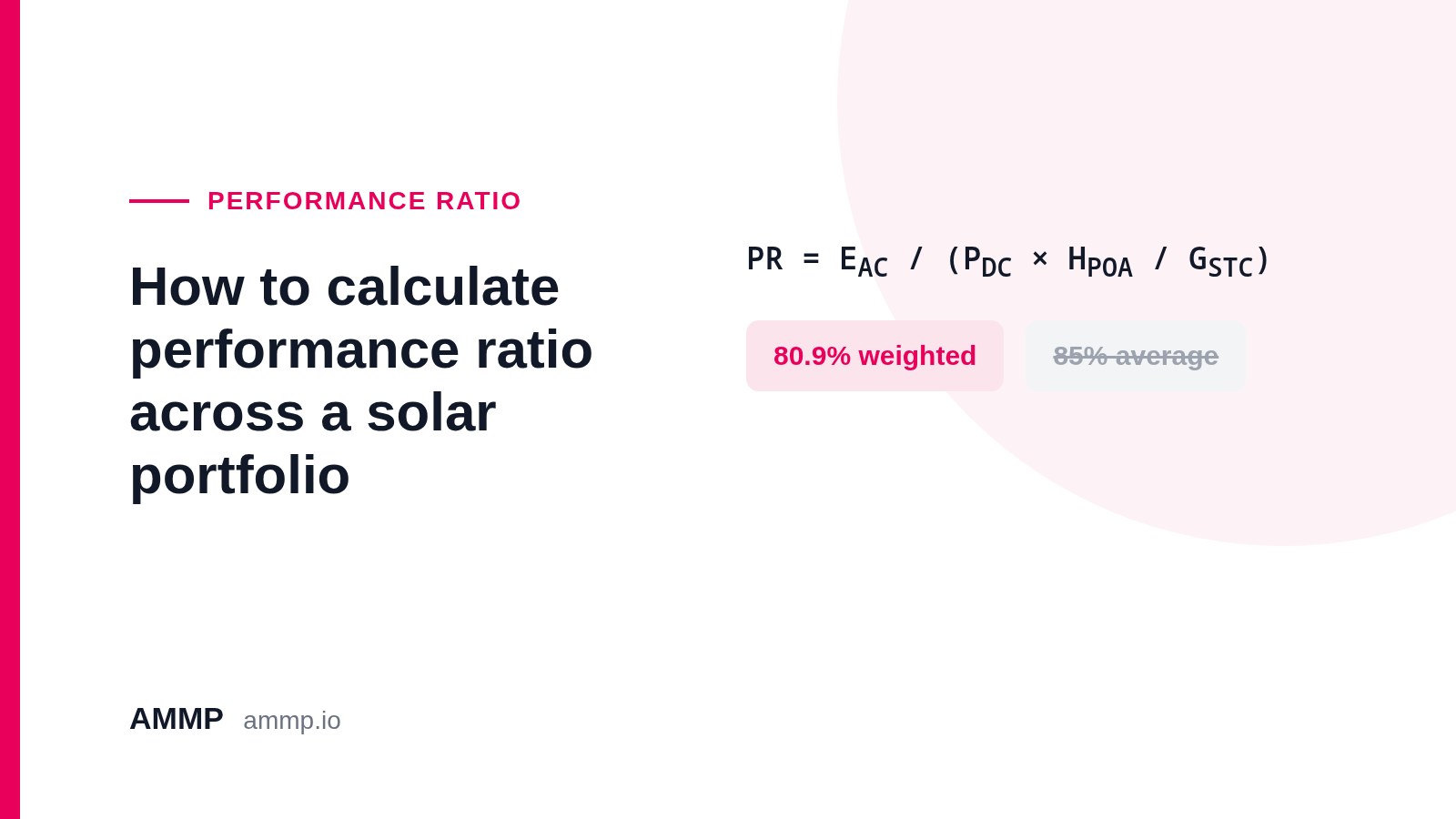
Performance ratio (PR) tells you how much of the energy the sun made available a plant actually turned into AC output. It's the most common health number in solar, and also one of the most often miscalculated once you have more than one site.
The formula
Under IEC 61724-1, PR compares the AC energy produced with what the installed DC capacity would produce at the measured irradiance:
PR = E_AC / (P_DC × H_POA / 1,000 W/m²)
E_AC is AC energy, P_DC is installed DC capacity and H_POA is plane-of-array irradiation over the period. Intervals with very low irradiance are usually excluded.
Which irradiance to use
- Plane-of-array sensor on site: the most precise option, as long as it's clean, correctly tilted and calibrated.
- Satellite irradiance: a useful backup when there's no sensor or it's faulty, but less precise. Treat a PR based on satellite irradiance as indicative, and don't use it to judge small losses.
Always record which source each PR figure used.
Temperature-corrected PR
Modules produce less when they're hot, so a plain PR drops in summer even on a healthy plant. Weather-corrected PR adjusts for module temperature using the module's temperature coefficient, which makes plants comparable across seasons and climates.
Why vendor-portal PR numbers aren't comparable
Each inverter portal may use a different irradiance source, a different low-irradiance cut-off, AC or DC capacity, and with or without temperature correction. Two sites at "85%" in two portals may not perform the same at all. For portfolio work, calculate PR yourself in one place, with one method, from the raw data. That is one of the questions to ask before you buy multi-brand monitoring.
Aggregating to portfolio level
Don't average site PRs. Sum the AC energy of all sites and divide it by the sum of their reference yields (capacity × irradiation / 1,000 W/m²). Then large sites count in proportion to their size.
Worked example (made-up round numbers, for illustration only):
- Site A: 1,000 kWp, 150 kWh/m² irradiation → reference 150,000 kWh. Produced 120,000 kWh → PR 80%.
- Site B: 100 kWp, 150 kWh/m² → reference 15,000 kWh. Produced 13,500 kWh → PR 90%.
- Simple average: (80% + 90%) / 2 = 85%, which is misleading.
- Energy-weighted: 133,500 / 165,000 = 80.9%, the real portfolio figure.
Common mistakes
- Mixing sensor and satellite irradiance without labelling them.
- Using AC capacity instead of DC capacity.
- Including night-time or very low-irradiance intervals.
- Averaging site PRs instead of weighting them by energy.
- Comparing summer PR with winter PR without temperature correction.
- Calculating PR over periods with missing data as if they were complete.
AMMP OS calculates both variants per IEC 61724-1. The method is documented in KPI calculations.
Frequently asked questions
What is a good performance ratio?
It depends on the technology, climate and method, so compare sites using the same method rather than against a single target.
Should I use weather-corrected PR?
For comparing sites or seasons, yes. It removes the effect of module temperature.
How do I calculate portfolio PR?
Divide the total AC energy by the total reference yield. Don't average site PRs.